



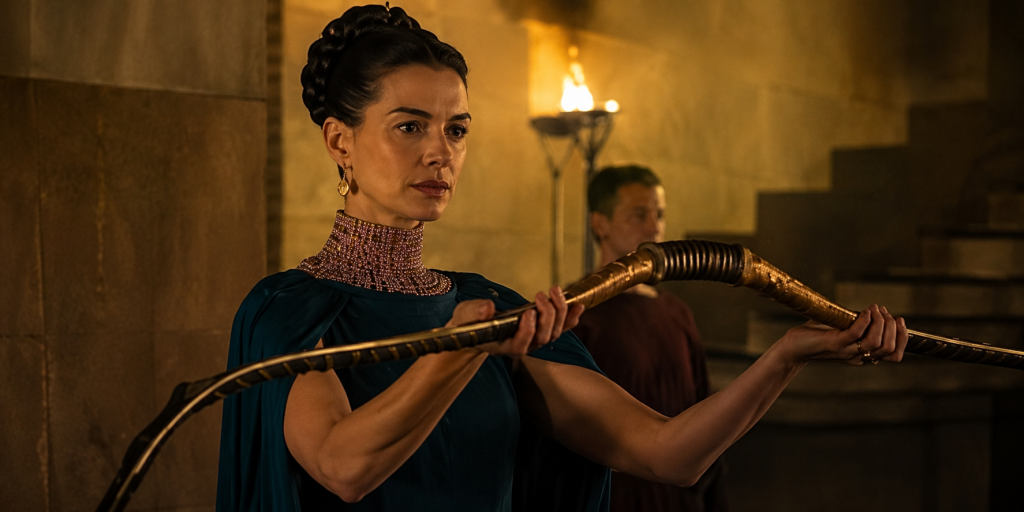
Christopher Nolan’s The Odyssey is, in many respects, a unique adaptation of Homer. Yet one of its most striking departures from the ancient epic lies in its treatment of female characters. While Homer’s women often function as powerful archetypes—beauty, wisdom, seduction, immortality, devotion—Nolan systematically strips many of these figures of their traditional symbolic attributes. The result is a reinterpretation that transforms the feminine landscape of the epic.
The most surprising aspect of this transformation is that it does not affect all women equally. Nearly every female archetype is revised, diminished, or complicated. Penelope, while not entirely untouched, emerges as the character who retains the greatest share of her original significance.
Helen: From Beauty to Wound
No figure illustrates this shift more dramatically than Helen.
In Homer, Helen is the most beautiful woman in the world. Her beauty is not a peripheral detail; it is one of the central symbolic forces of the Trojan cycle. The Greeks may fight for reasons of honor, power, alliance, and oath, but Helen’s beauty remains the mythic spark that ignites the conflict.
Nolan’s Helen is something entirely different.
Rather than emphasizing beauty, the film foregrounds visible scars and physical damage. The camera repeatedly draws attention to her wounds. Instead of inspiring desire, she evokes pity. Instead of appearing as the legendary woman who launched a thousand ships, she appears as one of the casualties of war.
The effect is startling. The mythic Helen disappears, replaced by a damaged survivor.
This choice appears deliberate. Nolan seems less interested in Helen as an object of projection than as a human being marked by history. Yet the transformation raises an uncomfortable question: if Helen no longer embodies extraordinary beauty, what remains of the symbolic force that once made her central to the myth?
The result is a Helen who is tragic but strangely diminished.
Circe: The End of Enchantment

Circe Offering the Cup to Odysseus by William Waterhouse
A similar process occurs with Circe.
In Homer, Circe is dangerous because she is seductive. She embodies enchantment, sensuality, and transformation. Men lose themselves in her world.
Nolan’s Circe retains the danger but loses much of the seduction. Rather than functioning as an erotic temptation, she feels closer to a figure from a horror film. The atmosphere surrounding her is unsettling rather than alluring.
The shift is significant.
In Homer, Odysseus must resist attraction. In Nolan, he must survive threat.
The archetype of the enchantress becomes the archetype of menace.
What is lost in the process is enchantment itself. Circe remains dangerous, but she is no longer irresistible.
Calypso: Paradise Without Desire
Calypso undergoes a similar reduction.
Traditionally she represents immortality, eternal youth, and divine beauty. She offers Odysseus something no mortal can possess: an escape from aging, death, and suffering.
Yet Nolan’s Calypso appears surprisingly human and ordinary. She does not embody eternal youth. She does not radiate divine perfection. She feels less like a goddess and more like another stop on Odysseus’ long journey.
Again, temptation loses its glamour.
The audience understands intellectually why Odysseus leaves, but not necessarily emotionally why remaining would have been so tempting.
Homer’s Calypso presents one of the greatest temptations in world literature. Nolan’s Calypso presents a place one can leave without much regret.
Athena: Wisdom Without Brilliance
Perhaps the most puzzling transformation concerns Athena.
In Homer, Athena is dazzling. She is strategic, intelligent, energetic, and deeply engaged in human affairs. She repeatedly rescues Odysseus through cleverness and foresight.
Nolan’s Athena is more subdued. While she remains important, she lacks the radiance and intellectual vitality traditionally associated with the goddess. She often appears distant, restrained, and emotionally muted.
The goddess of wisdom becomes almost clinical.
The archetypal force remains, but the charisma is diminished.
Penelope: The Last Stronghold of Meaning

Against this backdrop, Penelope stands apart. Yet she is not entirely identical to her Homeric counterpart.
In Homer, Penelope is far more than the faithful wife awaiting her husband’s return. She is intelligent, politically astute, psychologically complex, and capable of remarkable strategic deception. Her famous weaving ruse places her among the great tacticians of the epic. Like Odysseus, she survives through intelligence.

Penelope and the Suitors by William Waterhouse
Nolan preserves much of Penelope’s symbolic importance, yet shifts the emphasis from her intelligence and strategic ambiguity to her emotional significance. She becomes less a master tactician and more the emotional center of the narrative.
Even so, she retains a symbolic weight that the other women largely lose.
If Helen is diminished, Circe darkened, Calypso humanized, and Athena muted, Penelope remains the figure around whom the narrative ultimately revolves.
This asymmetry is too consistent to be accidental.
The Weakening of Archetype
One way to understand Nolan’s choices is through the lens of psychological development. The traditional feminine figures of The Odyssey embody enduring human fantasies and aspirations. Helen embodies ideal beauty. Circe embodies erotic fascination. Calypso embodies eternal youth. Athena embodies perfect wisdom.
Nolan repeatedly dismantles these ideals. Helen is wounded. Circe is unsettling. Calypso is ordinary. Athena is ambiguous.
Penelope participates in this process as well, though to a lesser degree. Some of her Homeric complexity is reduced, yet she remains the character who most successfully preserves her symbolic importance. Unlike the others, she continues to embody something enduring rather than something disenchanted.
Home Versus Fantasy
Whether one agrees with Nolan’s choices is another question. Some viewers may feel that the film sacrifices too much of Homer’s symbolic richness. Helen loses her magnetism. Circe loses her enchantment. Calypso loses her divinity. Athena loses her brilliance. Penelope loses her complexity.
Yet these transformations appear too systematic to be dismissed as mere casting decisions.
If Homer’s Odyssey is a journey through a landscape populated by living archetypes, Nolan’s Odyssey is a journey through their ruins. Beauty is scarred. Seduction is unsettling. Immortality is ordinary. Wisdom is muted. Only Penelope remains. In Nolan’s hands, the hero does not return to an ideal. He returns home.
Visuals are taken from fictionhorizon.com, elle.in, amazon.ca and wikipedia.
© 2026 Mahan Doğrusöz