



Mahan Doğrusöz: My first question is about your own professional journey. Today, you are widely recognized for your work in EMDR. Did your career begin with EMDR, or did you initially train in another therapeutic orientation?
Rotem Brayer: I did not start my career as an EMDR therapist. My background was fairly eclectic, with a strong foundation in cognitive and cognitive-behavioral approaches. Over the years, I completed training in Acceptance and Commitment Therapy (ACT), Dialectical Behavior Therapy (DBT), and several other modalities.
About ten years into my clinical practice, I attended my first EMDR training. From the very first day, I felt that this was different. I remember thinking, “This is why I became a therapist.”
Everything I had learned before was valuable, but EMDR offered a depth and transformative potential that I had been looking for all along. It quickly became my professional mission.
Mahan Doğrusöz: What was it about EMDR that had such a profound impact on you? How did it transform your understanding of psychotherapy and your work as a clinician?
Rotem Brayer: EMDR transformed the way I understood therapeutic change. Looking back, I realized that much of what I had done before was often helping clients cope or function better, but EMDR allowed me to reach the core of their difficulties.
I became a therapist because I wanted to help people experience deep, lasting transformation—not just symptom relief. During my basic EMDR training, I watched a demonstration that showed me how EMDR could bypass layers of defenses and access material that might otherwise remain out of reach.
That experience changed everything for me.
Mahan Doğrusöz: I was originally trained in the classical EMDR model developed by Francine Shapiro. However, about a year and a half ago, I discovered EMDR 2.0 and found it both fascinating and highly effective. In Türkiye, I sense a certain tension between proponents of traditional EMDR and those who embrace EMDR 2.0. There seems to be a degree of resistance among some clinicians who were trained in the original model. How do you understand this tension, and where do you position yourself within this discussion?
Rotem Brayer: I do think there are different camps within the EMDR community. However, that distinction is not particularly important to me. What matters most is what works best for the client. I do not see traditional EMDR and EMDR 2.0 as competing approaches. I typically begin with standard EMDR, but when I work with clients who present with complex trauma, significant dissociation, or difficulty accessing traumatic material, I integrate elements of EMDR 2.0, particularly strategies that tax working memory. For me, it is not an either-or question. My commitment is not to a particular camp; it is to my clients.
Mahan Doğrusöz: Out of clinical curiosity, why do you choose to proceed with classical EMDR first and only transition to EMDR 2.0 in certain cases? In my experience, when I put the two together, EMDR 2.0 feels like a laser beam—it is incredibly fast, highly effective, and results in fewer complications.
Rotem Brayer: I see EMDR 2.0 as a better fit for very complex trauma where people are genuinely struggling to go back and face those memories. In those instances, we really need to add the overtaxing of the working memory using specific techniques and strategies.
However, I find traditional EMDR to be highly effective on its own with certain clients. If there is no complex trauma or an explicit clinical need for 2.0, I don’t start with it because I don’t think it’s always necessary. I see plenty of excellent outcomes using regular EMDR. So, if it works, it works. But if I recognize in advance that it’s going to be a massive challenge for a client to sit and revisit those traumatic memories, or if we hit a wall, that is when I seamlessly bring the EMDR 2.0 elements into our work.
Mahan Doğrusöz: EMDR was initially developed as a treatment for post-traumatic stress disorder. Today, however, it is being used with a much broader range of presentations, including personality disorders, developmental trauma, and even psychotic disorders. How do you view this expansion of EMDR’s clinical applications?
Rotem Brayer: I see it as a very positive development because our understanding of trauma has evolved significantly. We no longer define trauma solely as catastrophic events such as natural disasters, assaults, or serious accidents. We now understand that trauma can also result from what did not happen: not being seen, not being nurtured, not feeling safe or connected during critical developmental periods. From the perspective of the Adaptive Information Processing model, trauma is any experience that has not been adequately processed by the brain. That can include both major traumatic events and the more subtle attachment wounds that shape a person’s development. EMDR’s expanding scope reflects this broader and more nuanced understanding of trauma.
Mahan Doğrusöz: I have noticed growing interest in using EMDR with psychotic disorders. Have you had any clinical experience using EMDR with these populations?
Rotem Brayer: I have, although this is an area that requires considerable experience, caution, and specialized knowledge. There are experts in the field, such as Dr. Paul Miller, who have made important contributions to the use of EMDR with psychosis. My experience has shown that some clients with psychotic disorders can benefit from EMDR, but it is not appropriate for everyone. When delusional belief systems are highly active, it can be challenging to access adaptive information and facilitate effective processing. This remains an emerging area of practice and an important frontier for future research.
Mahan Doğrusöz: One of the aspects of EMDR that I find particularly compelling is its capacity to integrate with other therapeutic approaches. Do you see EMDR primarily as a complementary method, or do you believe it has the potential to transform other schools of psychotherapy?
Rotem Brayer: I believe it can do both. In 2019, I started an online platform called the EMDR Learning Community (https://emdr-learning.com/), where we host a lot of free webinars exploring how different modalities integrate with EMDR.
Some of the most natural integrations are with parts-based therapies, such as Internal Family Systems (IFS) or ego state therapy, as well as somatic approaches like Somatic Experiencing. Attachment-informed EMDR is another exciting avenue. For instance, my colleague Mark Brayne teaches attachment-informed EMDR in the UK, focusing heavily on how to process those subtle, early relational wounds.
Ultimately, effective therapy requires flexibility because every client needs something a little different. If a client doesn’t relate to the language of parts work, I won’t force IFS interventions on them. However, almost everyone feels something in their body during processing, so drawing on somatic tools allows us to achieve much deeper processing. There are even new trainings emerging for pre-verbal EMDR to process memories from infancy. The integrative potential is vast.
Mahan Doğrusöz: I am currently training in Richard Erskine’s Integrative Psychotherapy model, which places a strong emphasis on attunement, co-regulation, and the therapeutic relationship. In my experience, EMDR fits remarkably well within this relational framework.
Rotem Brayer: I completely agree, and I actually write about this exact concept in my book. EMDR is not simply a mechanical technique. The therapeutic relationship, attunement, co-regulation, and the therapist’s presence are fundamental components of effective EMDR work. No psychotherapy approach can be reduced to a set of techniques. Before anything else, we are therapists. We must be the co-regulators who are attuned to what is going on with our clients on a moment-to-moment basis. The relationship is the core that holds the whole thing together.
Mahan Doğrusöz: I read a study showing that a high percentage of clinicians trained in EMDR are actually reluctant to use it, particularly psychodynamically oriented psychotherapists. What is your intuition behind this reluctance? Is it just the conservatism of the psychodynamic community?
Rotem Brayer: I think part of it is academic conservatism, but another major piece is that they often look at EMDR as a sort of “quick fix,” which is simply not true. While EMDR can work very quickly, at its core, it is a depth-oriented therapy. I have many colleagues who use EMDR explicitly as a depth-oriented modality.
Unfortunately, certain psychological communities view it as a surface-level tool that doesn’t align with their clinical depth, and I completely disagree with that notion. To highlight this, I have a new book coming out next month called EMDR As You Are. I am the editor of this project, and I brought together 12 experts from different parts of the world with diverse therapeutic backgrounds. The book shows how each professional brought their original training into EMDR. For example, we feature EMDR in spirituality by Alexandra Dent in the UK, EMDR for chronic pain by Mark Grant from Australia, and EMDR integrated with Jungian psychology by Dr. Andrew Dovo from Florida. It proves that you can bring your professional roots right into your EMDR work.
Mahan Doğrusöz: My final question concerns the future of EMDR. I’ve been following your videos over the last several months where you discuss new frontiers, specifically the integration of EMDR with psychedelic-assisted psychotherapy—using substances like psilocybin mushrooms, MDMA, and ketamine. What exactly do these medicines facilitate, and how do they transform the EMDR framework?
Rotem Brayer: The integration of EMDR with psychedelic-assisted therapies is undoubtedly one of the most significant emerging frontiers in psychotherapy. In the United States, Canada, Australia, and parts of Europe, there is a massive paradigm shift where substances once viewed solely as dangerous drugs are now recognized as powerful medicines.
What these medicines fundamentally add to the EMDR framework comes down to defense mechanisms. We all have defenses, but trauma survivors have exceptionally strong, rigid defenses. When used responsibly under carefully controlled clinical conditions, these medicines allow us to go right underneath those defenses. By bypassing the ego defenses, they grant the therapist and client access to the raw, underlying traumatic material, attachment wounds, or deeply entrenched experiences that need to be processed.
Of course, these treatments are not a blanket solution; they require rigorous screening, and there are major contraindications to consider. But when integrated with effective psychotherapy—whether it’s EMDR or IFS, which has also heavily adopted psychedelics—they allow clients to access and heal raw material that might otherwise remain entirely inaccessible.
Mahan Doğrusöz: Thanks so much for sharing your views and experience with me.
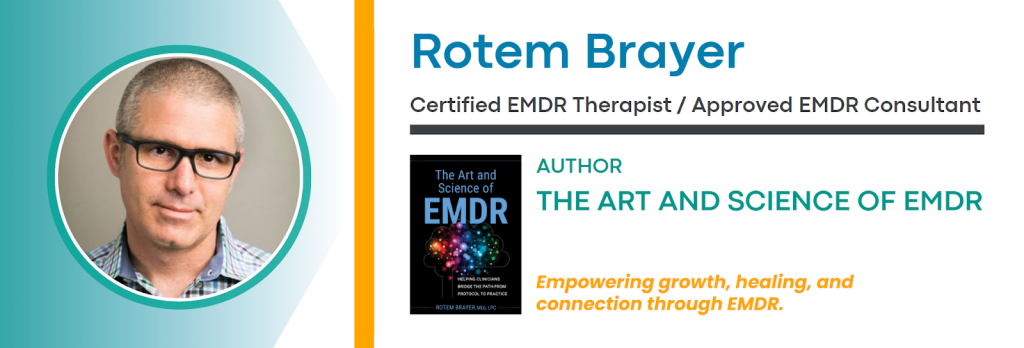
Rotem Brayer is a Licensed Professional Counselor (LPC), certified EMDR therapist, and advanced consultant specializing in trauma recovery and attachment wounds. As the founder of EMDR Denver and the EMDR Learning Community, he has become a leading educator in the mental health field, providing training to clinicians around the world to enhance their therapeutic skills. The author of The Art and Science of EMDR, Brayer regularly presents at national conferences on integrating neurobiology with trauma-focused approaches. Throughout his career, he has made significant contributions to the modern evolution of trauma therapy by bridging rigorous clinical protocols with relational and creative practices.