



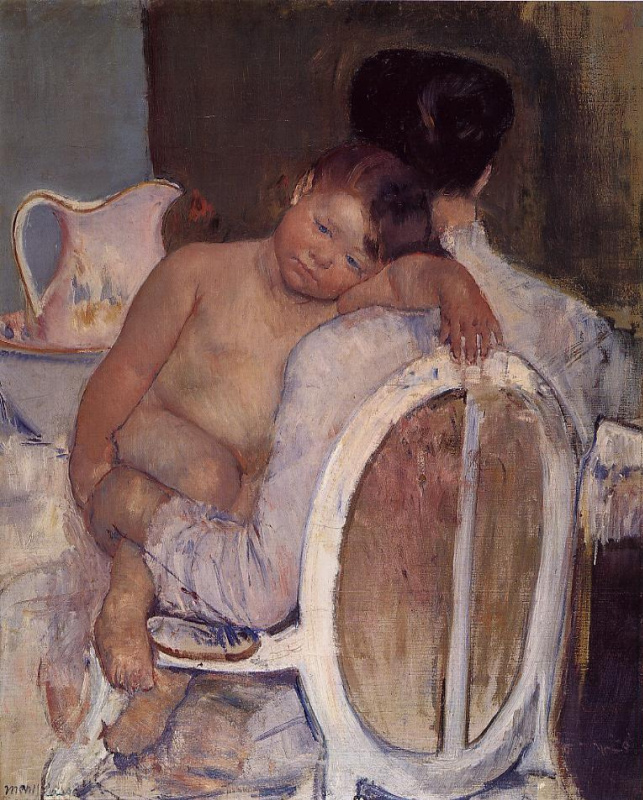
Mother and Infant by Paul Klee (1913)
In a previous essay, I compared Relational Psychoanalysis and Integrative Psychotherapy through their understanding of uncertainty. Although both traditions place the therapeutic relationship at the centre of clinical work, they approach uncertainty somewhat differently. Relational psychoanalysis often treats uncertainty as an enduring feature of genuine encounter, whereas Integrative Psychotherapy tends to organise it through developmental theory, relational needs, and therapeutic responsiveness.
Joyce Slochower’s Holding: Something Old and Something New (1996) invites a different comparison. Reading the paper, I was repeatedly reminded of Richard Erskine’s concept of the relational home. Although these ideas emerge from different theoretical traditions, both describe a therapeutic relationship that provides sufficient emotional safety for previously unarticulated experience to emerge rather than remain defended against. Exploring where holding and the relational home converge—and where they diverge—offers an illuminating dialogue between Relational Psychoanalysis and Integrative Psychotherapy.
Beyond Interpretation

Joyce Slochower
One of Slochower’s central arguments concerns the changing role of interpretation.
She suggests that therapeutic movement is often brought about not through interpretation itself but through the creation of an emotional space in which previously inexpressible experience can finally emerge. As she writes, clinical movement is sometimes effected “not by our capacity to make meaning but by our ability to create an emotional space within which inner experience can be articulated rather than challenged.” (Slochower, 1996, as cited in Aron & Harris (Eds.), Relational Psychoanalysis, Vol. II, 2015, p. 31)
This observation resonates strongly with Integrative Psychotherapy.
Erskine likewise argues that before experience can be interpreted, reorganised, or integrated, it must first be welcomed. The therapist’s initial task is not to explain the client’s experience but to provide sufficient relational safety for previously disowned feelings, memories, and unmet relational needs to become emotionally available.
Neither tradition rejects interpretation. Instead, both relocate it within a larger relational process. Interpretation no longer stands as the primary mechanism of change. Rather, it becomes meaningful because it occurs within a relationship capable of holding emotional experience. At times holding itself functions as an implicit interpretation; at other moments interpretation succeeds precisely because it is experienced as an act of holding.
Holding and the Relational Home
The closest point of convergence between the two traditions lies in Slochower’s concept of holding and Erskine’s relational home.
Holding is far more than comfort or reassurance. It refers to the therapist’s capacity to create a psychologically protected emotional space in which painful affect can be experienced, reflected upon, and gradually integrated without overwhelming the patient. The analyst remains emotionally available, non-retaliatory, psychologically alive, and capable of surviving the patient’s most disturbing emotional states.
Erskine’s relational home describes a remarkably similar therapeutic atmosphere. It is a relationship in which clients experience themselves as psychologically welcomed rather than corrected, analysed, or prematurely interpreted. Within that relationship, previously hidden or dissociated aspects of experience can gradually emerge because they encounter acceptance rather than challenge.
Both concepts therefore shift psychotherapy away from technique and toward relationship. Healing begins not because the therapist offers better explanations but because the relationship itself becomes sufficiently safe for new emotional experience to unfold.
If one were to observe Slochower and Erskine working with an emotionally overwhelmed client, their interventions might appear remarkably similar. Both would likely slow the pace of therapy, privilege emotional safety over interpretation, tolerate intense affect without retaliation, and respond to developmental vulnerability with patience rather than correction.
At the level of clinical practice, the convergence is striking.
Holding as a Co-Created Relationship
Slochower also rejects the idea that holding is something simply provided by the analyst.
Patients unconsciously participate in creating and sustaining the holding experience. Holding emerges through the interaction of two subjectivities rather than through one person’s caregiving alone.
This understanding resonates naturally with Thomas Ogden’s concept of the analytic third—the shared psychological field jointly created by analyst and patient—and with Integrative Psychotherapy’s understanding of contact as a mutual relational achievement.
Emotional safety is not delivered to passive patients. It is gradually negotiated and co-created within an evolving therapeutic relationship.
Where the Theories Diverge
If holding and the relational home describe remarkably similar clinical experiences, Slochower and Erskine explain those experiences differently.
For Slochower, holding cannot be understood apart from Winnicott’s concept of transitional illusion.
During certain phases of treatment, patients may temporarily experience the analyst as uniquely or almost perfectly responsive. Slochower does not regard this experience as pathological or as something to be corrected immediately. Instead, she argues that it serves a developmental function. Like Winnicott’s transitional space, it allows patients to internalise safety before gradually encountering the analyst’s inevitable separateness.
The paradox is central to her theory. Holding must feel sufficiently complete to foster psychological growth. Yet it can never actually be complete. The analyst is not the mother.
Indeed, Slochower repeatedly reminds us that holding has limits. Analysts misunderstand. Patients sometimes cannot receive what is offered. Perfect attunement is impossible. More importantly, if the experience of complete attunement were never relinquished, development itself would become arrested. The analyst’s separate subjectivity eventually becomes not a failure of holding but one of its developmental achievements.
Illusion, therefore, is not simply Slochower’s vocabulary. It is part of her explanation of why holding heals.
Integrative Psychotherapy approaches many of these same clinical phenomena from a different direction. Like Slochower, Erskine places enormous emphasis on attunement, emotional safety, developmental responsiveness, and repair following relational failures. Yet he rarely conceptualises therapeutic action through the language of transitional illusion.
Instead, his emphasis falls upon authentic relational responsiveness. The therapist’s presence is understood as a genuine interpersonal encounter in which inquiry, confirmation, validation, and emotional availability respond directly to unmet developmental needs in the here-and-now. The relationship itself—not a transitional illusion about the relationship—becomes the primary vehicle of change.
This does not mean that Integrative Psychotherapy rejects the importance of illusion. Rather, it does not place illusion at the centre of its explanatory model. Slochower explains holding through transitional experience and the gradual recognition of the analyst’s separateness. Erskine explains similar therapeutic processes through therapeutic presence, relational needs, and authentic contact.
The clinical behaviour may often appear remarkably similar. The theories explaining that behaviour are not.
When Theory May Shape Clinical Decisions
Whether these different theories consistently lead to different clinical decisions remains an open question, but they suggest interesting possibilities.
Imagine a patient saying, “You’re the first person who has ever completely understood me.”
A therapist influenced by Slochower might wonder whether this experience of nearly complete attunement serves an important transitional function. Rather than gently correcting the patient’s idealisation, the therapist may allow the experience to continue for a time, recognising its possible developmental value before the patient’s awareness gradually expands to include the analyst’s separate subjectivity.
An Integrative Psychotherapist might approach the same moment somewhat differently. Rather than thinking primarily in terms of transitional illusion, the therapist may become curious about the client’s lived experience of finally feeling understood. The emphasis would remain on exploring the unmet relational need that has found expression within the relationship and on deepening that authentic experience of contact.
These responses are not opposites. Both protect the relationship and avoid premature interpretation. Yet they reflect different assumptions about what is therapeutically most significant in that moment.
Whether these different metapsychologies ultimately produce different interventions remains an important question for future dialogue between the two traditions.
Conclusion
Comparing Slochower’s holding with Erskine’s relational home reveals both a remarkable convergence and an important divergence between Relational Psychoanalysis and Integrative Psychotherapy.
Clinically, both describe a therapeutic relationship in which emotional experience can finally emerge because it is met with steadiness, acceptance, developmental sensitivity, and emotional responsiveness. Both move therapeutic action away from interpretation as the primary agent of change and toward the creation of a relationship capable of containing experience before explaining it.
The difference lies in how that relationship is understood.
For Slochower, holding derives its transformative power partly from the patient’s temporary experience of transitional attunement and the gradual discovery that the analyst is both deeply responsive and ultimately separate. For Erskine, the relational home is conceived less as a transitional illusion than as an authentic interpersonal relationship in which unmet developmental needs can finally be recognised, responded to, and integrated.
The consulting room may therefore look remarkably similar while resting upon different theories of psychological change. Recognising both the convergence and the divergence enriches our understanding of each tradition. It reminds us that psychotherapy is shaped not only by what therapists do, but also by how they understand why those actions heal.
References
- Erskine, R. G., Moursund, J. P., & Trautmann, R. L. (1999). Beyond Empathy: A Therapy of Contact-in-Relationship. Brunner/Mazel.
- Ogden, T. H. (1994). The Analytic Third: Working with Intersubjective Clinical Facts. International Journal of Psychoanalysis, 75, 3–19.
- Slochower, J. (1996). Holding and Psychoanalysis: A Relational Perspective. Analytic Press.
- Winnicott, D. W. (1971). Playing and Reality. Tavistock.