


Dedicated to my dearest father Mustafa Feridun Doğrusöz who is the source of light within me.
We often think of our names as the first words in the story of our lives. Yet a name can become much more than an identifying mark. It can carry the history of a family, the imagination of a parent, the traces of distant cultures, and sometimes meanings that we only discover much later. In this sense, our names may become part of our self-narration: the ongoing process through which we make sense of who we are by connecting memories, experiences, and symbols into a personal story.
My name is Mahan. It was given to me by my father, a man with a deep interest in history. He was the one who introduced me to the historical associations of my name. He told me about Mahan Tigin, a ruler connected to the early Turkic world and the Göktürk period, and he also explained that in Persian the name carried meanings such as “moon-like” or “beautiful as the moon.”
I grew up with these two associations: one rooted in Turkic history, the other in Persian language and imagery. They became the starting point of a curiosity that has accompanied me throughout my life.
There is another curious aspect to my name: in all my years, I have never met another person called Mahan.
For decades, I have researched its origins, meanings, and historical references. One of the historical connections that particularly fascinated me was Mahan Tigin and the sixth-century Bugut inscription, a monument associated with the Göktürk period. The identification of the figure mentioned in relation to the name remains a subject of scholarly discussion, but the connection was meaningful to me. It gave my otherwise unusual name a place in a distant historical landscape.
I never imagined, however, that my search would eventually lead me to a literary character bearing the same name.
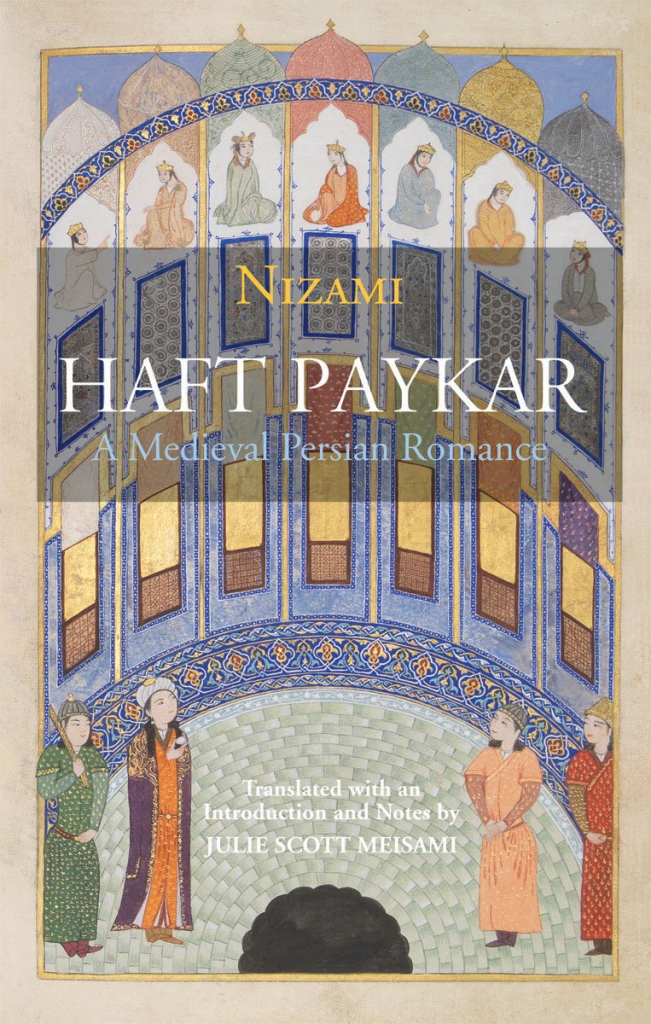
Only very recently, I discovered Mahan in Haft Paykar (The Seven Beauties), the celebrated narrative poem by the twelfth-century Persian poet Nizami Ganjavi, completed in 1197. What astonished me was not simply the coincidence of the name. It was the story itself. As I read it, I began to recognise themes and experiences that seemed remarkably close to my own life.
The Seven Domes and the World of Nizami
Before telling Mahan’s story, it is worth understanding the extraordinary literary and cosmological world in which it appears.
Haft Paykar tells the story of Bahram Gur, the legendary Sasanian king. He marries seven princesses from different regions of the world and builds seven magnificent domed pavilions for them. Each pavilion has a different colour and corresponds to one of the seven planets, the seven days of the week, and a particular region of the world.
The king visits a different pavilion on each day, and each princess tells him a story.
This structure reflects Nizami’s fascination with the intellectual and symbolic systems of his age. Medieval astronomy and astrology were not separate from philosophy, medicine, cosmology, or literature as they tend to be today. The movements of the planets, their colours, their qualities, and their supposed influences on human life formed an interconnected system of knowledge.
In this 16th-century Shiraz production, the architecture, tiles, gold embellishments and turquoise colour reveal reveal the symbolic world of the story.
The seven pavilions are therefore not merely architectural fantasies. They represent a universe ordered through planetary correspondences, in which colours, days, directions, human temperaments, and stories are woven together.
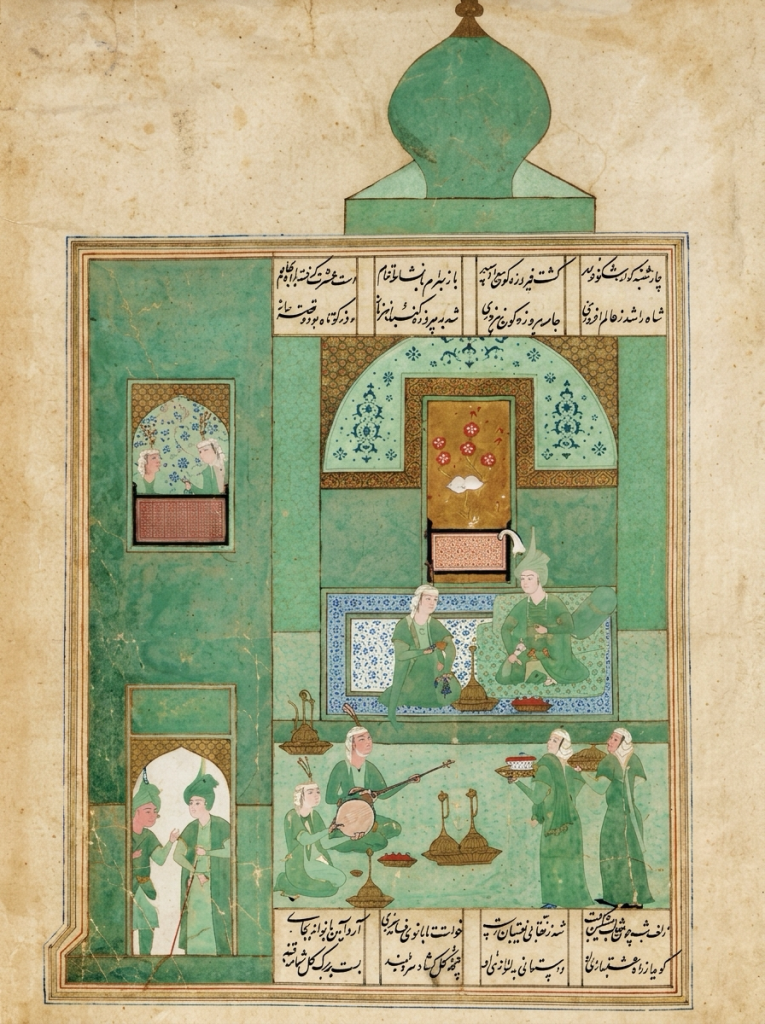
The story of Mahan is told on Wednesday, in the turquoise or blue pavilion, associated with Mercury. It is narrated by the Maghribi princess, whose name is Azargun.
It is a fitting setting. In the classical tradition, Mercury was the planet of Hermes: the god of travellers, merchants, tricksters and messengers, and the guide who led souls between worlds. Mahan’s story unfolds under this sign.
And so the story begins.
The Story of Mahan
Once upon a time, in Egypt, there lived a young man named Mahan. He was extraordinarily handsome, more beautiful than the full moon itself, and his appearance was compared to that of the biblical Joseph.
He had many friends, and they frequently gathered to enjoy music, food, and conversation.
One evening, a friend invited him to a garden. They spent the day eating, drinking, and enjoying one another’s company.
As night fell, Mahan found himself alone in the garden. There, he encountered a man who appeared to be a familiar friend and business partner. The stranger told him that he had returned from a distant journey with an enormous profit. His merchandise was waiting outside the city, and he invited Mahan to accompany him.
Delighted by the prospect of wealth, Mahan followed him.
They walked through the night, travelling farther and farther from the city. At dawn, the man suddenly disappeared. Mahan found himself alone in a desolate wilderness, exhausted and bewildered. The familiar world had vanished. During the day, he took refuge in a hollow in the ground.
The following night, he encountered a man and a woman who offered to guide him. They told him that he had lost his way and promised to take him somewhere safe. Trusting them, Mahan followed. But the farther he travelled, the more lost he became. The wilderness filled with the sounds and cries of supernatural beings. When morning came, his supposed guides had disappeared.
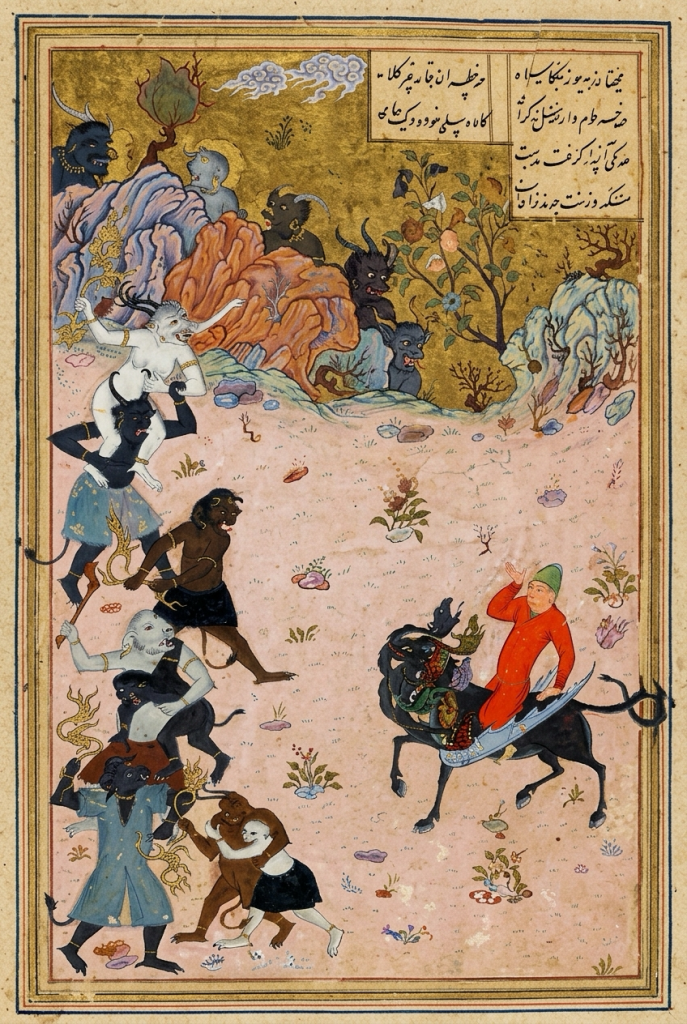
15th century miniature. In WOSCU’s 2023 publication on the Cultural Heritage of Uzbekistan, this illustration held at the British Library is introduced as one of Mahan’s terrifying encounters in the land of jinn.
On the third night, a rider appeared and offered him a horse. Mahan mounted it, believing that he was finally being rescued. But as they travelled through a strange landscape filled with music, dancing, and demonic revelry, the horse transformed into a monstrous, winged creature with multiple heads. It carried him through the night, tossing him across the landscape until dawn, when it threw him to the ground and disappeared.
Exhausted and almost defeated, Mahan continued his journey until he discovered a beautiful, flourishing garden.
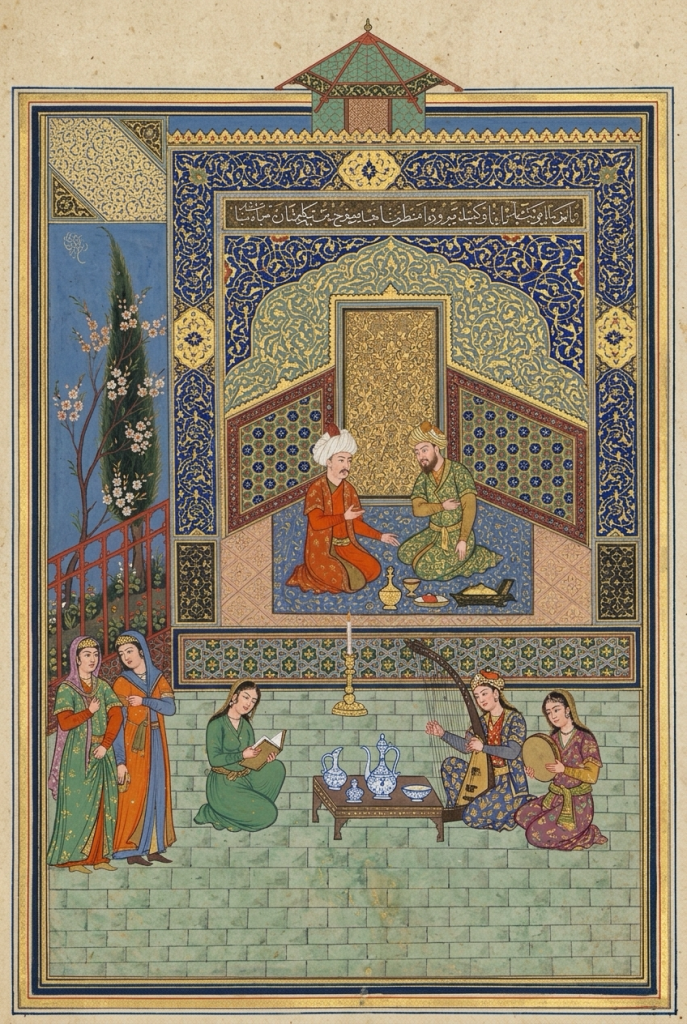
A manuscript folio that went up for auction in 2025 depicts Bahram Gur’s visit to the blue/turquoise pavilion. It has been identified as a 15th-century Herat production from the second half of the century. Rather than Mahan’s adventure, this scene depicts the palace setting where the story is narrated.
Its elderly owner initially mistook him for a thief. But after hearing his story, the old man softened and offered him protection. He even proposed adopting Mahan as his son and giving him the garden and its riches.
There was, however, one condition.
That night, Mahan was to climb a tree and remain there, no matter what he saw or heard. He must not come down.
Mahan obeyed. From his elevated position, he watched as beautiful women arrived carrying candles. They brought music, food, and wine, and organised a magnificent feast beneath the tree. Their leader, a woman of extraordinary beauty, eventually noticed him and invited him to join them.
Mahan struggled with the temptation. He remembered the old man’s warning, but the music, the beauty, and the promise of pleasure gradually overcame his restraint.
He descended.
The woman welcomed him, offered him food and wine, and drew him into her embrace. But at the very moment he surrendered to her beauty, her appearance changed. The lovely woman became a hideous ifrit, a terrifying supernatural creature with enormous teeth. Mahan was horrified and fainted.
When he opened his eyes, it was morning.
The garden had disappeared. In its place lay a desolate ruin. The magnificent feast was nothing but decay: the beautiful setting had become a place of death, and what had appeared to be paradise was revealed as a terrifying illusion.
Mahan was devastated. He wept, recognised his own folly, and begged God for forgiveness and protection.
At that moment, a man dressed in green appeared before him. He was Khidr (Hızır), the mysterious spiritual guide who appears in Islamic tradition as a figure of divine wisdom and guidance.
Khidr told Mahan to give him his hand, close his eyes, and open them again.
When Mahan did so, he found himself back in Egypt, in the very garden from which his journey had begun. His friends had believed him dead and were mourning his disappearance. He told them everything he had experienced.
From that day onwards, Mahan adopted turquoise clothing, the colour worn by his friends in mourning, and made it his permanent colour.
The story ends with this transformation. Mahan has returned home, but he is no longer quite the same person who left it.
Mahan and the Hero’s Journey
When I first read this story, I was immediately reminded of Joseph Campbell’s concept of the Hero’s Journey, or the monomyth.
In The Hero with a Thousand Faces (1949), Campbell identified a recurring narrative structure in myths and legends across different cultures. The hero leaves the familiar world, crosses a threshold into the unknown, undergoes a series of trials, experiences a symbolic death or transformation, receives help or guidance, and eventually returns to the world from which he departed.
Mahan’s journey follows this pattern remarkably closely.
His departure begins with an invitation and the promise of wealth. By following the supposed business partner, he crosses the threshold between the familiar world and an unfamiliar, dangerous reality.
The wilderness becomes a landscape of successive trials. The false guides, the monstrous horse, the deceptive garden, and the beautiful woman who turns into a demon are all variations of the same fundamental challenge: the inability to distinguish appearance from reality.
His encounter with the ifrit represents the decisive ordeal. The world he believed to be beautiful reveals its terrifying underside. The experience destroys his former sense of certainty.
Khidr then appears as the wise guide, the figure who makes the return possible. Through his intervention, Mahan crosses the threshold once more, returning to his original world with a transformed understanding of life.
There is a particularly interesting connection here with Campbell’s concept of the Belly of the Whale: the stage in which the hero is symbolically separated from his former identity and undergoes a kind of death before emerging transformed.
Of course, Nizami was not consciously applying Campbell’s theory, which was formulated centuries later. Rather, both works reveal the persistence of a narrative pattern deeply rooted in human imagination: the idea that transformation often requires leaving the familiar, encountering the unknown, and returning with a different understanding of oneself.
Interestingly, this is not merely a modern interpretive connection. A 2017 academic study by Mohammad Reyhani and Raheleh Abdollahzadeh Barzoo examined the archetypal elements of Mahan’s story through Campbell’s monomyth theory. The authors interpret Mahan’s journey as an encounter with the depths of the unconscious, followed by the rediscovery of an inner guiding principle and a return to consciousness.
A Sufi Reading: From Illusion to Truth
There is, however, another dimension to Mahan’s story that I find particularly compelling: its potential Sufi symbolism.
From a Sufi perspective, the journey can be understood as an allegory of the human soul’s movement from illusion towards spiritual awareness.
Mahan initially lives in a world of pleasure, friendship, beauty, and worldly desire. His first temptation is wealth. He follows a false friend because he is attracted by the promise of material gain. His journey begins with an attachment to the external world.
The subsequent encounters repeat the same lesson in different forms. The people who offer to guide him are not what they appear to be. The horse that promises transportation becomes a monster. The garden that appears to be paradise conceals a terrifying reality.
The most powerful image is undoubtedly the beautiful woman who transforms into a hideous creature.
Here, Nizami explores the distinction between zahir (the outward or apparent) and batin (the inward or hidden). What appears beautiful to the senses may conceal something destructive. The senses, when governed by unexamined desire, can lead us away from truth.
This is not simply a condemnation of physical beauty or human desire. It is a warning against mistaking appearances for reality and allowing attachment to external pleasures to determine the direction of one’s life.
The garden itself is particularly significant. At first, Mahan sees it as paradise. Yet the same place becomes a wasteland when the illusion disappears. The transformation suggests that the problem lies not only in the external world, but also in the way human consciousness perceives it.
Mahan’s awakening begins with recognition. He sees the consequences of his own choices, acknowledges his vulnerability, and turns towards God.
Then Khidr appears.
In Islamic mystical tradition, Khidr is associated with divine wisdom, spiritual guidance, and knowledge that transcends ordinary understanding. His presence in the story is therefore more than a convenient narrative rescue. He represents the possibility of guidance when human knowledge and ordinary perception have reached their limits.
Mahan’s return is made possible through a gesture of trust: he gives Khidr his hand and closes his eyes.
I find this image particularly beautiful. Having spent so much of his journey being deceived by what he sees, Mahan must finally close his eyes in order to find his way home.
He returns to the world of his friends, but his relationship with that world has changed.
And the final image is the turquoise garment.
Turquoise is the colour of the Wednesday pavilion, associated with Mercury in Nizami’s cosmological scheme. It is also the colour of mourning in the story. Mahan adopts it permanently, carrying the memory of his experience into his ordinary life.
His transformation has become visible. The journey is over, but its meaning remains with him.
Finding Myself in Mahan
I have spent years researching the origins and historical meanings of my name. My father gave me its first historical associations, and my curiosity about them became a lifelong pursuit. I never expected to discover a literary character bearing that name, let alone one whose story would resonate so deeply with my own experience.
What struck me was not the coincidence alone, but the emotional and symbolic parallels.
I recognised something of my own journey in Mahan’s encounters with deception, in the gradual loss of familiar certainties, in the experience of finding oneself in unfamiliar territory, and in the difficult process of distinguishing what is real from what merely appears to be real.
I also recognised the importance of returning — not necessarily to the same place, or to the same people, but to a more authentic relationship with oneself.
Perhaps this is what makes the Hero’s Journey such a powerful metaphor. It does not promise a life without suffering or disillusionment. It suggests that experiences which initially seem to destroy our sense of direction may eventually become part of a larger process of transformation.
I do not believe that a name determines a person’s destiny. Nor do I need to believe that the discovery of this story was written somewhere in advance.
But there is something extraordinary about encountering, after so many years of searching for the meaning of one’s name, a character from a medieval Persian poem whose journey seems to echo one’s own.
My father gave me the name Mahan. He told me about its historical roots in the Turkic world and its poetic associations with the moon in Persian. He could not have known that, centuries earlier, a Persian poet had given the same name to a young Egyptian man whose journey would become a story about illusion, loss, spiritual guidance, and return.
Perhaps self-narration is partly about this: discovering unexpected connections between the stories we inherit, the stories we encounter, and the stories we live.
I began by researching the history of my name.
I ended up finding myself in a story written more than eight centuries ago.
And perhaps, like Mahan, I am still learning what it means to come home.
References
- Nizami Ganjavi, Haft Paykar (1197); C. E. Wilson, trans., The Haft Paikar (1924).
- Julie Scott Meisami, The Haft Paykar: A Medieval Persian Romance (Oxford University Press, 1995).
- Joseph Campbell, The Hero with a Thousand Faces (1949).
- Mohammad Reyhani and Raheleh Abdollahzadeh Barzoo (2017), “Archetypal Elements in Mahan’s Story in Haft Paykar Based on Campbell’s Monomyth Theory.”
- Christine van Ruymbeke, Science and Poetry in Medieval Persia (Cambridge University Press, 2008).