


You can take away a man’s gods, but only to give him others in return.’
— C. G. Jung

I first heard of Osho when I was at university. I cannot say that I gave him much thought. From the little I knew, I simply filed him away in my mind as yet another New Age lunatic, one of those flamboyant spiritual figures who seemed to flourish in the peculiar cultural atmosphere of the late twentieth century. I was studying psychology and there were all the serious questions of the human psyche waiting to be explored. A bearded guru surrounded by followers in orange robes hardly seemed worthy of my attention.
And so, for decades, I never bothered to look more closely.
What gradually began to puzzle me, however, was how often Osho’s name came up among people whom I considered exceptionally well read, intellectually sophisticated and culturally curious. They did not necessarily describe themselves as his followers, but they spoke about him with admiration. They quoted him. They recommended his books. There was sometimes an almost affectionate fascination with the man.
I found this perplexing. What exactly were these intelligent people seeing that I wasn’t?
The question remained somewhere at the back of my mind until, while researching the counterculture of the 1960s and the Hippie Trail, I came across a documentary about a woman who had participated in the hippie movement and later became a follower of Osho. That accidental encounter led me to Wild Wild Country, the Netflix documentary series about Osho—then still known as Bhagwan Shree Rajneesh—his formidable secretary Ma Anand Sheela, and the extraordinary commune they established in Oregon during the 1980s.
Remarkably, I had never even heard of the series. I began watching out of curiosity and soon realized that I had stumbled upon something far more interesting than the eccentric story I had expected. Rajneeshpuram was almost a laboratory of psychological phenomena: charismatic authority, idealization, narcissism, projection, group identity, persecution, aggression, dependency, grandiosity, moral disengagement and the extraordinary human hunger for belonging.
The question that interested me was no longer whether Osho was a charlatan. A much more interesting question had emerged: What did Osho provide that thousands of intelligent, educated people apparently needed?
The Guru as Selfobject
Heinz Kohut’s self psychology offers an illuminating way of approaching this question. Kohut departed from a psychoanalytic tradition that tended to regard narcissistic needs primarily as immature remnants to be overcome. Instead, he understood certain relational needs as fundamental to the maintenance of a cohesive self throughout life.
We need to be seen. We need people whom we can admire and temporarily experience as larger, calmer or stronger than ourselves. And we need the experience of finding others who resemble us—people whose existence tells us that we are not alone in the world.
Kohut described these experiences through the selfobject functions of mirroring, idealization and twinship. Seen through this lens, Osho begins to look less like an inexplicable historical curiosity. He was offering all three. The mirroring message was enormously powerful: You are not ordinary. You are awake. You have had the courage to question the dead conventions that imprison everyone else. You are capable of becoming something more. For someone feeling anonymous or insignificant in modern society, this can provide an intoxicating restoration of self-esteem.

Osho also provided an idealizable selfobject. He presented himself as extraordinarily free: free from conventional morality, sexual repression, religious dogma, social anxiety and ultimately even the ordinary limitations governing other human beings. To stand close to such a figure is psychologically different from merely agreeing with his ideas. One participates in his greatness. If this extraordinary person sees something in me, perhaps I too am extraordinary.
And then there was twinship. Rajneeshpuram offered something modern societies increasingly struggle to provide: an intense experience of belonging. Imagine arriving among thousands of people who seem to say: You never fitted into conventional society? Neither did we. You questioned traditional morality? So did we. You wanted spirituality but could no longer believe in the religion of your parents? We understand. You wanted intensity, sexuality, meditation, music, dancing, experimentation and transcendence? So do we. Suddenly the alienated individual discovers a tribe.
Osho was therefore not the only selfobject. The entire commune became a selfobject environment.
After the Death of God
There is another dimension to this story that I find difficult to ignore. Most of Osho’s Western followers came from societies that had undergone an extraordinary transformation. Max Weber famously described modernity in terms of the disenchantment of the world. Rationalization, bureaucracy and scientific explanation progressively displaced a universe once saturated with sacred meaning. Nietzsche announced the same catastrophe much more dramatically: God is dead.
Neither observation can be reduced simply to declining church attendance. Something much larger was happening. The traditional structures through which human beings had located themselves within a meaningful cosmos were losing their authority.
Yet the disappearance of religion does not necessarily entail the disappearance of religious needs. Human beings continue to long for transcendence, ritual, belonging, idealization and experiences larger than the isolated self. Modernity may dismantle the structures that once contained these needs without eliminating the needs themselves.
And here my perspective is inevitably shaped by the world from which I come. Turkey more broadly has certainly undergone enormous secularization and modernization. Yet the sacred has never disappeared from everyday life in quite the same way. The call to prayer continues to punctuate the day. Religious rituals remain woven into family and communal life. Ancient mosques, tombs, saints, superstitions, prayers, amulets and inherited customs coexist quite comfortably with smartphones, psychotherapy and modern medicine. God, one might say, is still very much alive.
Nor have communal structures disappeared completely. Extended families, neighbourhood ties and religious communities—some of them rooted in traditions extending back centuries—continue to offer forms of belonging and continuity.
This does not make Turkey immune to charismatic authority. Quite the contrary: traditional communities can produce their own forms of submission, idealization and abuse. But the psychological hunger may take a different form. When established religious and communal structures already provide ritual, transcendence, belonging and idealizable figures, the vacuum into which a newly manufactured spiritual guru can step may be smaller.
In the radically individualized societies from which many of Osho’s followers came, the situation was different. The old God had disappeared. But the psychological need for something resembling God had not. And Osho was waiting.
Osho and Sheela: A Co-created Madness
Then there is Ma Anand Sheela. Perhaps the greatest mistake would be to understand the Rajneeshpuram catastrophe through the simple opposition offered after its collapse: either Osho was an innocent spiritual teacher whose movement was hijacked by his monstrous secretary, or Sheela was merely the manipulated victim of an exploitative guru.
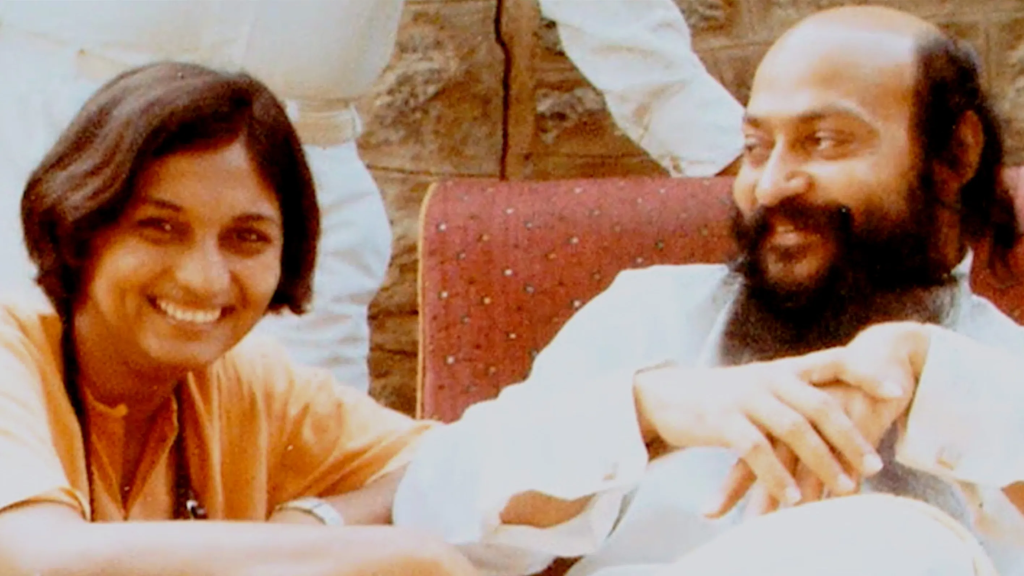
Their relationship appears psychologically far more interesting than either story allows. I am tempted to describe it—not diagnostically, but metaphorically—as a kind of folie à deux, a co-created madness organized around narcissistic needs.
From a Kohutian perspective, the relationship may have involved extraordinary reciprocal selfobject functions. For Sheela, Osho was the ultimate idealizable selfobject. Through him, she became special. She was not simply Sheela. She was the woman chosen by Bhagwan. His secretary. His representative. The person entrusted with transforming a spiritual vision into physical reality. And what a transformation it was. She helped build a city. She commanded an organization. She confronted politicians and journalists. Thousands of people knew her name. The ordinary self could disappear into identification with something immeasurably larger.
This is why I would hesitate to describe codependency as passivity. A codependent person can be extraordinarily active, aggressive and powerful. Indeed, dependency upon an idealized narcissistic object can mobilize enormous agency. One can lie for the object. Fight for the object. Commit crimes for the object. Sacrifice oneself for the object. Because the psychological equation has become: His greatness is our greatness. His survival is our survival. An attack upon him is an attack upon us.
Sheela could therefore simultaneously be servant and queen. But the regulation may have worked in the opposite direction as well. If Osho was Sheela’s idealized selfobject, Sheela and the commune could provide Osho with an extraordinary mirror. Look what has been created around you. Thousands surrender themselves to you. A city exists because of you. People travel across continents to hear you. An entire social world has organized itself around your presence. Osho mirrors Sheela’s specialness by choosing her. Sheela mirrors Osho’s omnipotence by building his kingdom. He makes her extraordinary. She makes him omnipotent.
And the followers mirror them both.
The result is no longer simply a narcissistic leader surrounded by passive victims. It becomes a narcissistic regulatory system in which each part helps maintain the psychological reality of the others.
There is another possible complementarity. Osho could remain the guru because Sheela could become the general. She could administer, confront, threaten, organize and carry aggression while he remained associated with enlightenment and transcendence.
In psychodynamic language, one might say that she could carry aspects of the aggression that the idealized spiritual figure could not comfortably contain within his public identity.
None of this proves that Osho ordered particular crimes committed at Rajneeshpuram, nor should psychological interpretation be confused with historical evidence. But psychologically, explicit orders are not always necessary. In highly idealized hierarchical systems, followers can become extraordinarily skilled at discerning what the leader desires. They may perform functions for the leader that allow him simultaneously to enjoy their consequences and remain psychologically—or legally—distant from their execution.
“Our Commune Was an Opera”
One of the moments in Wild Wild Country that disturbed me most occurs when Sheela looks back upon Rajneeshpuram with something approaching romantic grandeur. She compares the commune to an opera. Operas, after all, end in tragedy. And the people of Oregon, in her formulation, were almost fortunate to have had this extraordinary opera brought to their doorstep. The entitlement contained in this image is breathtaking. The people whose lives were disrupted become spectators in her opera. Their fear becomes scenery. Their community becomes a stage. Their suffering becomes part of the dramatic grandeur of somebody else’s story.
Yet psychologically the metaphor may be doing something even more important. It preserves meaning. If Rajneeshpuram was an opera, then its destruction was not merely the disastrous consequence of human decisions. It was tragedy. Imprisonment becomes sacrifice. Grandiosity becomes vision. Collapse becomes destiny. Victims become characters. Osho becomes a tragic protagonist. Sheela becomes a tragic heroine. And therefore nothing was meaningless.
Perhaps the psychologically most threatening interpretation would be considerably less dramatic. Perhaps there was no opera. Perhaps a group of people became intoxicated with an idealized charismatic leader, constructed an increasingly closed world around themselves, divided humanity into enlightened insiders and hostile outsiders, progressively abandoned ordinary moral restraints and eventually harmed other people. No cosmic tragedy. No historical destiny. Just human beings and the consequences of their actions. For a grandiose self-system, that banality may be more difficult to tolerate than guilt itself.
Intelligence Will Not Save Us
I returned, finally, to the question that had originally puzzled me. Why had I repeatedly encountered intelligent, cultivated and highly educated people who remained fascinated by Osho? I now think the question itself contained a mistaken assumption. I had assumed that intelligence should protect people from figures like Osho.
Why should it?
There is no university degree that exempts a human being from having a self. Education does not eliminate our need to be mirrored. Intelligence does not eliminate our desire to idealize. Sophistication does not abolish our longing to encounter people like ourselves. Knowledge does not make loneliness disappear. And rationality does not eliminate our need for meaning.
Kohut’s great contribution was to understand that these are not embarrassing residues of childhood that psychologically mature people simply leave behind. Mirroring, idealization and twinship belong to the architecture of human psychological life. We remain relational creatures.
The danger begins when one person, ideology or community succeeds in monopolizing these functions. Only here are you truly understood. Only we know the truth. Only he can show you who you really are. The outside world cannot understand us.
At that point, criticism of the leader no longer feels like disagreement about another person. It can begin to feel like an attack upon the psychological structure through which the follower experiences meaning, belonging and self-worth. And this may be particularly seductive in an atomized and disenchanted world.
The great irony of Osho’s movement is therefore difficult to miss. It promised radical freedom from authority while creating extraordinary dependence upon an authority. It promised individuality while constructing an intensely collective identity. It promised liberation from illusion while eventually producing a social world increasingly insulated from corrective reality. And it promised people that they could finally discover themselves. Through him.
Perhaps this is why the story of Osho and Rajneeshpuram deserves more than ridicule. Calling the followers gullible and the guru mad allows us to reassure ourselves that nothing similar could happen to us. Kohut leaves us with a much more uncomfortable possibility. The vulnerabilities upon which charismatic figures depend are not peculiarities of ‘foolish’ people. They are built from the same needs that make all of us human: the need to be seen, the need to admire and the need to belong. The more fragmented and atomized the world becomes, the more urgently we may search for people and communities capable of answering those needs.
Most will answer them imperfectly but harmlessly. Some will answer them beautifully. And occasionally someone will answer them so completely that we hand over something we should never have surrendered: our capacity to doubt. Perhaps that is the real warning contained in the strange opera of Osho, Sheela and Rajneeshpuram. No amount of intelligence can protect us from being human and all the vulnerabilities that come with it.
An Afterthought
There is one final irony that is difficult to resist. Perhaps Osho did succeed in changing the world after all or, more accurately, perhaps he understood remarkably early what kind of world was coming. His peculiar marriage of spirituality, sexual liberation, radical individualism, wealth, consumption, and unapologetic pleasure no longer looks quite as outrageous as it did in the 1970s and 1980s. The commune disappeared, but something of its ethos seems strangely familiar today: desire without restraint, consumption without embarrassment, sexuality increasingly detached from commitment, and spirituality repackaged as another form of self-optimization. Perhaps Osho did not create this world at all; perhaps he was simply one of its most flamboyant early prototypes. There is something profoundly tragic in imagining him looking at us now, surrounded by dating apps, luxury wellness retreats, mindfulness brands, influencers, and the endless commercialization of the self.
Vİsuals are taken from nofilmschool.com, tvinsider.com and newyorker.com.
Note that the video is embedded via YouTube and all rights belong to the respective rights holders.