



Psychotherapy takes place in shifting territories. Some moments unfold through language and narrative; others emerge through silence, gesture, bodily tension, fantasy, memory, or an inexplicable feeling neither therapist nor client can yet articulate. Human beings rarely exist in only one register of experience, and because of this, no single therapeutic theory can fully contain the complexity encountered in the consulting room.
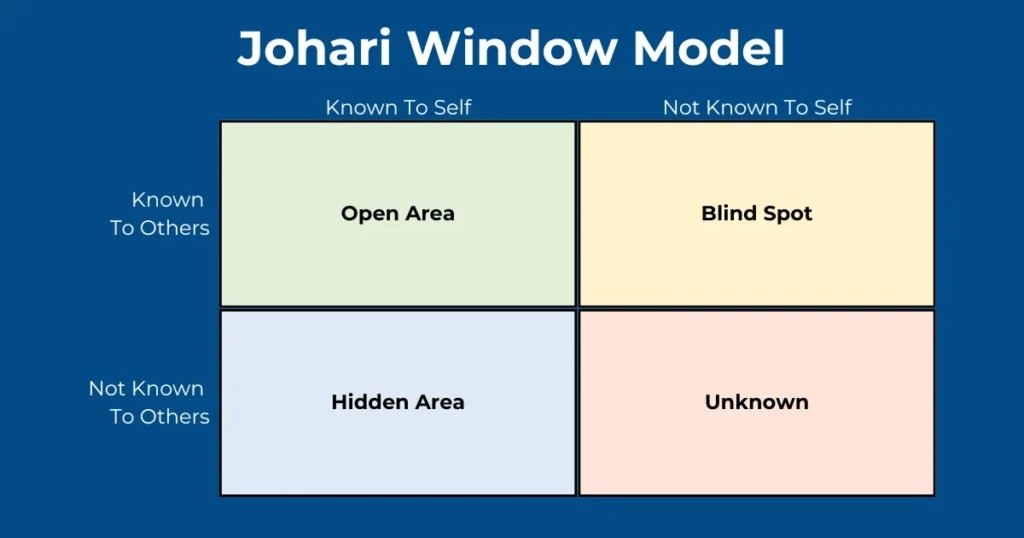
One useful way of understanding this multidimensional process is through the lens of the Johari Window. Originally developed as a model of interpersonal awareness, the Johari Window offers an elegant framework for understanding the evolving movement between what is known, hidden, discovered, and still unnamed within psychotherapy itself.
Taken from bearms.today
At first glance, therapy may appear to be a conversation between two people about identifiable problems. Yet beneath the apparent simplicity of dialogue lies an intricate dance between conscious awareness, relational dynamics, bodily experience, unconscious processes, and emotional truths still struggling toward language. Each quadrant of the Johari Window corresponds not only to dimensions of selfhood, but also to distinct therapeutic realms that require different forms of attunement and intervention.
The Open Area: Shared Reality and the Therapeutic Alliance
The Open Area consists of what is known both to the client and the therapist. This is the visible terrain of therapy: symptoms, life history, relationships, current conflicts, and explicit emotional experiences. It is the place where language functions most clearly and where therapeutic collaboration begins.
This is often the “safe” region of the session. The client says, “I feel exhausted,” “My relationship is failing,” or “I fear abandonment,” and both therapist and client can recognize the emotional content being discussed. Here, integrative relational work, supportive interventions, cognitive restructuring, psychoeducation, and reflective dialogue can all be deeply valuable.
Yet even within this apparently transparent realm, complexity remains. Two clients may describe identical symptoms while inhabiting radically different internal worlds. One person’s anxiety may emerge from unresolved grief; another’s from developmental trauma; another’s from chronic bodily hypervigilance; another’s from existential dread. Surface similarity conceals profound structural difference.
This is precisely why theoretical rigidity becomes dangerous. A therapist devoted exclusively to one explanatory system may prematurely reduce living human complexity into predetermined categories. The client ceases to become a person and instead becomes an example of theory.
The Open Area demands humility. It asks therapists to remain curious rather than doctrinaire.
The Blind Spot: What the Client Cannot Yet See
The Blind Spot contains what is visible to others but not yet recognized by the self. Here, psychodynamic and relational traditions become especially powerful. Patterns emerge in speech, posture, repetition, relational enactments, defensive maneuvers, contradictions, and transferential dynamics long before the client consciously perceives them.
A client may repeatedly describe themselves as “unlovable” while simultaneously pushing others away through hostility or emotional withdrawal. Another may intellectualize every feeling while insisting they are “emotionally open.” Someone else may unconsciously recreate childhood relational wounds within the therapeutic relationship itself.
The therapist’s task here is not to impose interpretation as absolute truth, but to gently illuminate emerging patterns. Insight must never become domination. Interpretation offered without sensitivity risks humiliating the client or reinforcing defenses. Timing matters as much as accuracy.
In this realm, psychotherapy resembles a collaborative act of discovery rather than a delivery of expertise. The therapist does not stand above the client as the owner of truth. Instead, therapist and client move together toward increasing awareness.
Importantly, even the therapist possesses blind spots. Countertransference reactions, personal history, theoretical loyalties, and unconscious biases shape perception. The therapeutic encounter is never one-sided observation. Two subjectivities are always present.
This recognition alone destabilizes fantasies of theoretical purity. No orientation possesses a monopoly on truth because every clinician sees through partial lenses.
The Hidden Area: The Realm of Secrecy and Vulnerability
The Hidden Area includes experiences known to the client but concealed from others. Shame, fear, aggression, envy, sexuality, dependency needs, fantasies, grief, and traumatic memories often reside here.
Clients do not reveal themselves simply because a therapist asks questions. Disclosure emerges through safety, trust, attunement, and the gradual development of relational permission. This is where phenomenological inquiry becomes indispensable. Rather than forcing meaning onto experience, the therapist learns to accompany the client into the texture of lived reality.
“What happens inside you when you say that?”
“Where do you feel this in your body?”
“What is the emotional atmosphere of that memory?”
“What feels difficult to reveal right now?”
Such questions invite experience rather than demand confession.
The Hidden Area reminds us that therapy is not merely analytical excavation. It is also relational hospitality. Human beings often hide not because they are resistant, but because exposure once carried danger. What appears as “defensiveness” may actually represent an intelligent adaptation to earlier relational environments.
Different therapeutic modalities become useful at different moments within this quadrant. Cognitive approaches may help organize fragmented experience. Relational approaches may repair shame through connection. Parts work may allow conflicting internal states to coexist without annihilating one another. Existential inquiry may help the client tolerate ambiguity and freedom.
No single model is sufficient because no single human process is occurring.
The Unknown: The Territory Beyond Language
The final quadrant — the Unknown — contains what is unknown both to therapist and client. This is perhaps the most mysterious and transformative dimension of psychotherapy.
Here we encounter experiences that have not yet entered symbolic thought. Sensations without narrative. Emotions without names. Bodily memories that precede language. Traumatic imprints encoded somatically rather than verbally. Unformulated experience.
In this territory, approaches such as EMDR, body-oriented psychotherapy, and Eugene Gendlin’s Focusing become profoundly important. The therapist listens not only to speech but to pauses, muscular shifts, breath, gaze, nervous system activation, and the subtle emergence of what Gendlin called the “felt sense” — a vague, bodily knowing that contains meaning before meaning becomes clear.
Sometimes the deepest truths emerge not through explanation but through trembling, tears, silence, imagery, or a sudden sensation in the chest that neither person initially understands.
The Unknown demands tolerance for uncertainty. It asks therapists to relinquish omniscience and remain present without prematurely organizing experience into familiar theoretical structures.
This is difficult within cultures of professional certainty. The temptation to immediately explain, diagnose, categorize, or interpret can become a defense against the anxiety of not knowing. Yet psychotherapy often progresses precisely through sustained contact with ambiguity.
The psyche is not a machine awaiting correct interpretation. It is alive, layered, contradictory, embodied, and relational.
Against Theoretical Fanaticism
One of the greatest dangers in psychotherapy is theoretical fanaticism — the belief that one model alone explains the entirety of human suffering. Such rigidity inevitably flattens the personhood of the client.
Human beings exceed our frameworks.
A cognitive therapist may encounter preverbal trauma that cannot initially be reached through cognition alone. A psychodynamic therapist may overlook the stabilizing usefulness of behavioral tools. A body-oriented therapist may underestimate the importance of narrative meaning-making. An exclusively neuroscientific approach may fail to grasp existential despair, symbolic life, or relational longing.
Theories are maps, not territories.
They are languages for approaching reality, not replacements for reality itself.
A mature therapist develops the capacity to move fluidly between modalities while remaining anchored in the deeper needs of the client rather than in loyalty to ideology. Integration does not mean theoretical chaos or superficial eclecticism. Rather, it means recognizing that different dimensions of human experience require different forms of listening.
At times the client needs interpretation.
At times regulation.
At times witnessing.
At times cognitive structure.
At times silence.
At times bodily processing.
At times relational repair.
At times grief work.
At times simply another nervous system capable of staying present.
Psychotherapy is therefore less about defending schools of thought and more about cultivating responsiveness to the complexity of human experience itself.
The consulting room is not fertile ground for theoretical absolutism because reality continuously exceeds our categories. The living psyche resists simplification. Every client arrives as a singular world — shaped by body, memory, attachment, culture, fantasy, language, trauma, desire, and history.
No single theory can fully grasp such richness.
And perhaps the deepest wisdom in psychotherapy lies precisely there: in remaining intellectually rigorous while also humble enough to recognize that every theory illuminates only part of the human mystery.