



Do I contradict myself?
Very well then I contradict myself,
(I am large, I contain multitudes.)’Walt Whitman
One of the most persistent assumptions about psychological life is also one of the most intuitively questionable: that somewhere beneath our conflicts, contradictions, and changing states lies a single, coherent self. We speak as though the same “I” loves and hates, approaches and withdraws, feels confident in one moment and helpless in another. Psychotherapy has often shared this assumption, treating contradiction as something requiring explanation and fragmentation as something requiring repair.
Yet clinical experience repeatedly confronts us with a rather different picture. A competent professional may become astonishingly helpless in the presence of a critical parent. A person who experiences herself as independent may feel like an abandoned child when a partner withdraws. Someone who longs intensely for intimacy may become cold and inaccessible the moment intimacy becomes available. Clients themselves frequently describe these experiences in the language of multiplicity: “A part of me wants to leave, but another part cannot imagine living without him”; “I know there is nothing to be frightened of, but something inside me is terrified”; “I don’t understand why I become a completely different person around my mother.”
Contemporary psychotherapy has developed several languages for understanding such experiences. Internal Family Systems speaks of parts. Ego State Therapy works explicitly with differentiated ego states. Transactional Analysis describes Parent, Adult, and Child ego states. Integrative Psychotherapy attends to archaic and developmentally organized states of self in the context of unmet relational needs. Relational psychoanalysis, particularly in the work of Philip Bromberg, conceptualizes personality in terms of multiple self-states whose accessibility to one another may be facilitated or restricted by dissociation.
These traditions cannot simply be collapsed into one another, nor do they constitute a single historical lineage. Their theoretical assumptions and clinical practices differ considerably. Yet they converge around a striking proposition: the human mind may be better understood as inherently multiple rather than fundamentally unitary.
Remarkably, one of the earliest psychoanalytic thinkers to take this possibility seriously was working within Freud’s own circle.
Paul Federn and the Experiential Ego
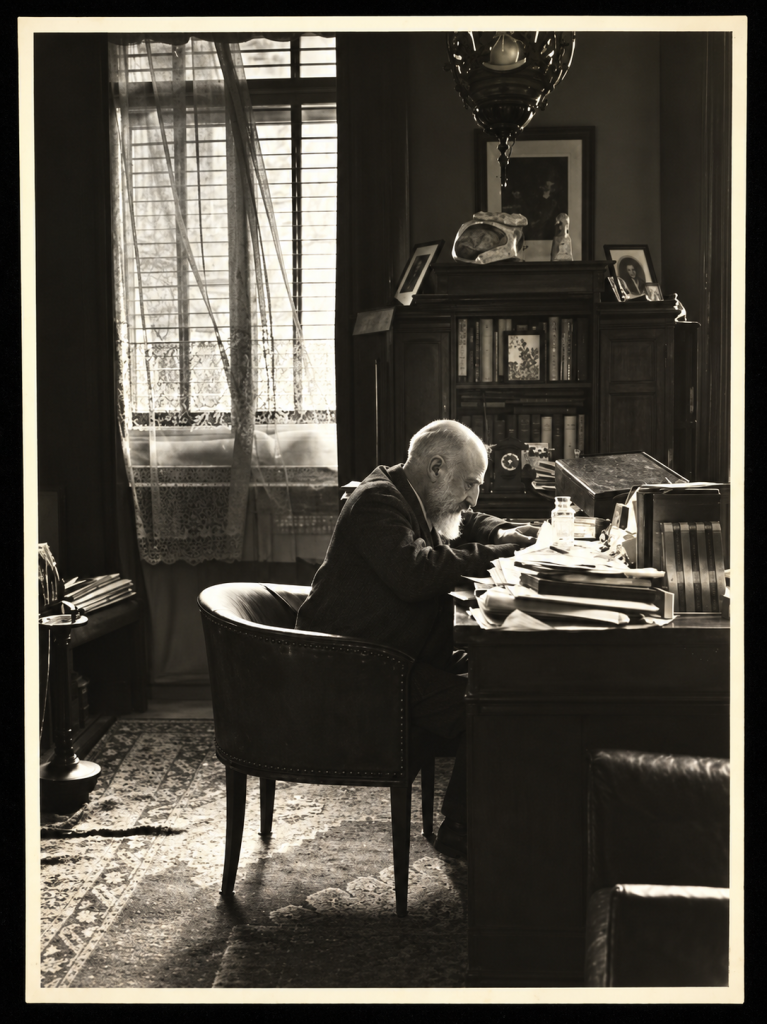
Paul Federn in his Study, 1930s
Paul Federn (1871–1950) belonged to the first generation of psychoanalysts and was a longstanding member of Freud’s Vienna Psychoanalytic Society. Yet his understanding of the ego developed in a direction that differed in important respects from Freud’s metapsychological account.
Freud’s structural theory conceptualized the ego principally in terms of its functions and its relations with the id, superego, and external reality. Federn became particularly interested in something more phenomenological: what does it feel like to have an ego?
Central to his thinking was Ichgefühl, usually translated as ego feeling. Federn was interested in the quality of “me-ness” or “mine-ness” accompanying experience—the ordinarily unremarkable sense that I am the person having this thought, this feeling, this bodily experience. Closely related was his concept of ego boundaries: the experienced distinction between what belongs to the self and what belongs to the world outside it.
This concern became particularly important in Federn’s work with psychotic states, but it also led him toward a broader insight. The ego need not be phenomenologically identical across all moments of a person’s life. Different configurations of affect, memory, bodily experience, perception, and relationship could constitute different ego states.
The importance of this idea becomes clearer when translated into ordinary clinical experience. A forty-five-year-old woman speaking confidently about her professional life may experience herself as competent, autonomous, and capable. Ten minutes later, while describing an encounter with her mother, her voice may change, her posture contract, and her expectations of the other become radically different. She does not merely remember having once been a frightened child. Something of that earlier organization of experience becomes present. The question therefore changes from: Why is this otherwise competent adult behaving irrationally? to What organization of self is present at this moment? That apparently small shift would have enormous consequences for later psychotherapy.
From Ego States to Structured Multiplicity
Federn did not produce contemporary “parts therapy,” and it would be historically misleading to portray the many approaches that followed as straightforward descendants of his work. Nevertheless, one identifiable line of development leads from Federn’s ego psychology into Eric Berne’s Transactional Analysis.
Berne transformed the idea of ego states into the familiar Parent–Adult–Child model. Importantly, the Child ego state was not simply childish behaviour. It could represent the reactivation in the present of ways of feeling, thinking, perceiving, and relating organized during childhood. The past was therefore not merely remembered; it could become psychologically present as a state of being.
John G. Watkins and Helen H. Watkins subsequently developed Ego State Therapy into a more explicit therapeutic approach. Ego states could possess relatively differentiated affects, memories, needs, beliefs, and protective functions. Some could remain largely outside ordinary awareness until activated by particular circumstances.
Here the clinical implications become profound.
Consider a patient who says: “One part of me knows this relationship is destructive and wants to leave. Another part becomes terrified whenever I think of leaving.” A unitary model of mind encourages us to ask which position represents what the patient “really” wants. A multiplicity model allows another possibility: Both experiences are real. They may belong to differently organized states of self, formed under different conditions and attempting to solve different psychological problems.
The therapeutic question therefore becomes less concerned with deciding which state is correct and more interested in understanding the function of each:
What does this state fear?
What does it expect from other people?
What is it trying to prevent?
When did this solution become necessary?
What does it need that it could not previously obtain?
Contradiction ceases to be merely evidence of irrationality. It becomes psychologically meaningful.
Psychoanalysis Rediscovers Multiplicity
Meanwhile, psychoanalysis arrived at related territory through different theoretical routes.
Object relations theory progressively challenged the image of an internally homogeneous ego. Fairbairn’s account of ego splitting connected differentiated ego structures with internalized object relationships. The psyche could contain different relational organizations, each carrying its own relationship between self and other.
Kernberg would later conceptualize internal experience in terms of configurations linking self-representation, object-representation, and affect. A person might therefore move between organizations such as:
dependent self – fear – abandoning other
and
powerful self – contempt – weak other.
The same external person may consequently be experienced very differently depending upon which self–object–affect configuration becomes dominant.
This represents an important advance over simply saying that a person possesses several “parts.” What changes across psychological states is not only the experience of who I am, but simultaneously the experience of who you are.
A frightened self may encounter a dangerous other. A compliant self may encounter a demanding other. A grandiose self may encounter an inferior other. A helpless self may encounter an omnipotent rescuer.
Multiplicity is therefore inherently relational.
From Multiple Selves to the Relational Self
This insight becomes particularly important with the relational turn in psychoanalysis.
Stephen Mitchell’s relational perspective helped shift psychoanalytic attention away from a mind understood primarily as an isolated arena of instinctual conflict toward a self constituted and reorganized within relational matrices. The person I become with my mother may not be identical to the person I become with my lover, my employer, or my therapist.
This raises an intriguing question: Which of these is the real self? The relational answer increasingly becomes: the question itself may be mistaken. Rather than searching behind these configurations for a single authentic psychological occupant, we can understand selfhood as involving multiple organizations of experience that emerge in different relational contexts.
Few relational psychoanalysts developed this idea as explicitly as Philip Bromberg. For Bromberg, the existence of multiple self-states is not itself pathological. Psychological health does not require the elimination of multiplicity in favour of a perfectly unified self. The crucial issue is whether different self-states can remain sufficiently connected that a person can move among them without losing a sense of psychological continuity.
Dissociation becomes important here. When particular states of self contain experiences that cannot safely coexist with others, communication between them may become restricted. The individual may know something in one state that becomes psychologically inaccessible in another. Therapeutic integration, from this perspective, does not mean fusion. It means increasing the capacity to “stand in the spaces” between different states of being.
This is a radically different understanding of psychological integration. The therapeutic aim is no longer necessarily to make the many into one, but to make it possible for the many to know one another.
A Crucial Relational Addition: Why This Self, With Me, Now?
Relational psychoanalysis adds another dimension that becomes particularly important clinically.
Suppose a client suddenly becomes compliant, frightened, suspicious, seductive, helpless, or hostile during a session. A parts-oriented therapist might reasonably ask: Which part has appeared?
A relational therapist adds another question: What has happened between us that has made this particular state of self possible—or necessary—at this moment?
Self-states are not simply psychological objects stored inside the patient awaiting discovery. They may become organized, intensified, or transformed within particular relationships. And the therapist is not outside this process.
A patient’s frightened self-state may encounter—and perhaps evoke—a rescuing therapist. A defiant state may emerge in relation to a therapist experienced as controlling. A compliant patient may meet a therapist who unconsciously enjoys being idealized. Through enactment, the self-states of patient and therapist may begin to organize one another.
The question therefore expands once again: Not simply Which self-state is present? but Which state of you is meeting which state of me, and what kind of relationship are we creating together?
At this point, the history of multiplicity enters the territory of intersubjectivity.
IFS: A New Language for an Old Problem?
Internal Family Systems has brought the language of psychological multiplicity to a remarkably broad contemporary audience. Richard Schwartz’s model proposes that the mind is naturally multiple and conceptualizes parts according to characteristic functions, particularly Managers, Firefighters, and Exiles, while distinguishing these from the qualities associated with Self.
IFS should not simply be described as Ego State Therapy repackaged. It emerged from a different theoretical context, particularly systems thinking, and developed its own conceptual architecture and therapeutic method.
Nevertheless, viewed against the longer history of psychotherapy, many ideas now associated popularly with “parts work” have clear precedents. Perhaps one of IFS’s most consequential achievements has therefore been not the discovery of multiplicity but its normalization.
Having parts need not indicate severe fragmentation or psychopathology. Ordinary psychological life is multiple. IFS also gives particularly accessible expression to another idea that has gradually transformed psychotherapy: a troublesome part may be protective rather than pathological. The controlling part, perfectionistic part, emotionally detached part, compulsively accommodating part, or fiercely independent part is therefore approached with curiosity:
What are you trying to accomplish? and, more importantly: What are you afraid would happen if you stopped doing it?
The symptom acquires a history. And once a symptom has a history, it often acquires meaning.
Integrative Psychotherapy: From Multiplicity to Relational Need
Richard Erskine’s Integrative Psychotherapy provides another meeting place for these ideas. Its roots include Transactional Analysis and ego-state thinking, but its emphasis extends beyond identifying differentiated states of self toward understanding the developmental and relational conditions under which particular organizations became necessary.
The therapist might recognize that the apparently self-sufficient adult is organized around an earlier conclusion: “Needing someone is dangerous.” But identifying the organization is only the beginning.
Inquiry explores the person’s phenomenological experience. Attunement attempts to meet that experience at the developmental and affective level at which it is organized. Validation communicates that the experience makes sense within the person’s history. Normalization recognizes the adaptive function of a response that may now appear dysfunctional. Therapist involvement and presence create the possibility of a different relational experience.
Thus the question moves from: Which part is this? to What happened that made this way of being necessary? and then What relational need could not be met when this organization developed?
A child who learned not to cry may not primarily require instruction in emotional expression. The prohibition against crying may once have preserved attachment to caregivers unable to tolerate vulnerability. The “strong” self-state is therefore not simply a defence to be dismantled. It may represent an intelligent developmental solution.
Integration requires respecting the solution before inviting the possibility that it is no longer necessary.
From Pathology to Adaptation
Across these very different traditions, one of the richest clinical consequences of multiplicity is therefore a transformation in how therapists understand symptoms.
Consider perfectionism. A deficit-oriented formulation might ask How do we reduce the patient’s perfectionism? A multiplicity-informed formulation asks Which organization of self requires perfection, and what does it believe perfection prevents?
The answer might be humiliation. Rejection. Loss of attachment. Chaos. Worthlessness.
The therapeutic stance changes immediately.
Similarly, when a patient says: “I’m ridiculous. I’m fifty years old and when my partner doesn’t call me I feel like an abandoned five-year-old.” The therapist need not choose between the rational fifty-year-old and the terrified child. The contradiction itself contains information.
A developmentally organized self-state may carry an experience that has never been integrated with the person’s adult capacities. The task is therefore not to inform the “five-year-old” that she is actually fifty. She already knows this in another state of mind.
The therapeutic task is to make it increasingly possible for what one state knows to become available to another. This is a very different conception of change.
The Reduction of Shame
There is another clinical consequence that deserves particular emphasis: multiplicity can reduce shame. Clients frequently arrive in therapy ashamed of their own inconsistency:
“I know better, but I still do it.”
“I don’t understand why I become like this.”
“I am strong everywhere except in relationships.”
“I promised myself I would never let this happen again.”
A unitary conception of self can inadvertently intensify the accusation contained in these statements. If there is only one “me,” and I genuinely know better, then my failure to act accordingly begins to look like weakness, irrationality, or lack of will.
Multiplicity offers another possibility.
The person who “knows better” and the person who becomes terrified may not, at that moment, have equal access to the same emotional knowledge, expectations, memories, or capacities.
Instead of: “What is wrong with me?” the client may begin asking “What happens to me?” And eventually “Which state of me is here, what does it know, what does it fear, and what has it been trying to do for me?”
That movement from judgment toward curiosity may itself be therapeutic.
Beyond the Search for the True Self
Perhaps multiplicity also requires psychotherapy to relinquish one of its oldest fantasies: that beneath defences, adaptations, false selves, ego states, and relational configurations there must exist one definitive psychological person waiting to be uncovered.
The frightened child, competent professional, accommodating partner, angry protector, dependent lover, and fiercely independent adult need not compete for the status of the “real” person.
Each may represent a historically meaningful organization of experience.
This does not mean that all states are equally adaptive, nor that psychological integration becomes irrelevant. Rather, it changes what we mean by integration.
Integration need not mean homogenization.
A psychologically integrated person may remain multiple while developing greater communication, flexibility, and continuity among different states of being. Experiences that once had to remain segregated can increasingly coexist.
“I need people” no longer has to annihilate “I can survive alone.”
“I am angry with you” no longer has to destroy “I love you.”
“I am frightened” need not exclude “I am competent.”
“I was once helpless” need not mean “I am helpless now.”
Contradictory states can become parts of a larger psychological conversation.
From the Multiple Ego to the Intersubjective Mind
Seen from a century’s distance, Federn’s early interest in ego states appears remarkably prescient. This is not because contemporary relational psychoanalysis, Ego State Therapy, IFS, and Integrative Psychotherapy can all be traced directly to Federn; they cannot. Their histories, assumptions, and methods remain distinct.
What Federn anticipated was a problem that psychotherapy would repeatedly rediscover.
The self is not as unitary as it appears.
Berne translated multiplicity into observable ego states. Watkins and Watkins developed methods for communicating therapeutically with differentiated states. Object relations theorists showed that different organizations of self are inseparable from different organizations of the internalized other. Relational psychoanalysis located multiple self-states within living relational contexts. Bromberg demonstrated how dissociation may separate states that cannot safely coexist. IFS made psychological multiplicity accessible and explicitly non-pathological. Integrative Psychotherapy connected differentiated states of being with developmental adaptation, unmet relational needs, attunement, and therapeutic presence.
Across these traditions, the clinical question has gradually changed. We once asked What is wrong with this person? Increasingly, we learned to ask What happened to this person?
Multiplicity allows us to go further: Which self-state learned to survive what happened—and what does it still expect to happen now? Relational thinking adds one final question: What is happening between us that allows this particular self-state to emerge here?
Perhaps the most enduring legacy of the ego-state idea, then, is not simply the proposition that there are many selves within us. It is the clinical freedom that follows from taking that multiplicity seriously.
The frightened child, the competent adult, the compliant partner, the angry protector, and the self that insists it needs no one no longer need to compete for the status of the true person. Each can be approached as a historically meaningful organization of experience. Therapy becomes a place in which previously disconnected ways of being may encounter one another, understand the relationships that made them necessary, and discover within a new relationship that they no longer need to remain isolated.
The history that began with the question of whether the ego could exist in different states may ultimately have led psychotherapy toward a more radical idea: psychological integration does not require us to become one, but to become capable of being many without losing our sense of continuity.
Note on the visual: Las dos Fridas by Frida Kahlo, 1939.