


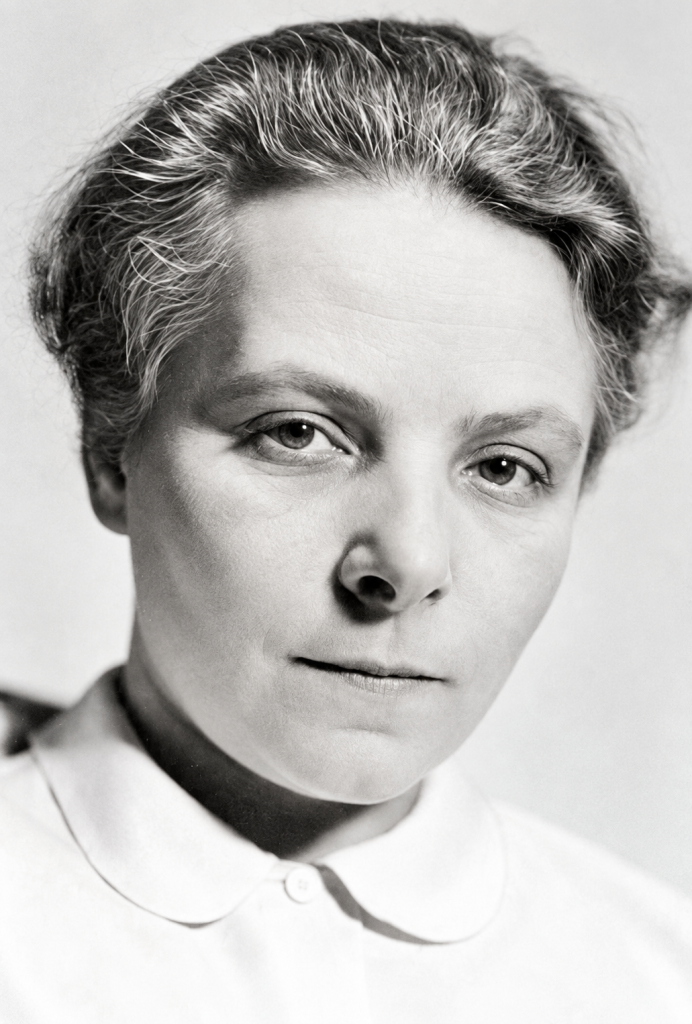
Edith Jacobson (1897–1978)
The history of psychoanalysis is often told through its great names and the schools of thought they established. Freud gave us the unconscious, Klein transformed our understanding of the internal object world, Kohut placed the self at the center of psychoanalytic inquiry, and Kernberg developed a structural theory of personality organization. Yet behind some of these influential developments stand thinkers whose contributions have received far less recognition.
Edith Jacobson (1897–1978) was one of them.
A German-born psychoanalyst who was imprisoned by the Nazis for her involvement in anti-fascist activities before emigrating to the United States, Jacobson went on to become an important figure in American ego psychology. Her intellectual legacy, however, extends far beyond that tradition.
In her landmark book The Self and the Object World (1964), Jacobson explored questions that would become central to subsequent developments in psychoanalysis: How does a human being develop a sense of self? How do we come to distinguish ourselves from others? How do our earliest relationships shape our internal world? And how do we integrate contradictory feelings and experiences into a coherent and enduring sense of identity?
One of Jacobson’s most significant contributions was her distinction between the ego and the self. While the ego referred to an organized system of psychological functions, the self encompassed the individual as a whole. She further distinguished the self from the self-representation, the mental representation through which an individual experiences and understands themselves.
For Jacobson, the development of the self was inseparable from the development of object representations. In early infancy, representations of the self and others are not yet clearly differentiated or integrated. Through maturation and repeated experiences with caregivers, the child gradually develops the capacity to distinguish between self and other and to integrate positive and negative experiences into increasingly stable representations.
The ability to experience oneself as the same person across different emotional states, and to recognize that others can be both loving and frustrating, is therefore a developmental achievement.
This understanding had profound implications for psychoanalytic thinking. Jacobson demonstrated that psychopathology could not be understood solely in terms of instinctual conflict and defensive operations. It also required attention to the development of self-representations, the internalization of early relationships, and the individual’s capacity to maintain a stable sense of identity and self-esteem.
Her work helped establish a conceptual bridge between classical ego psychology and the emerging developments in object relations theory.
It also contributed to the intellectual foundations of two influential, yet substantially different, approaches to the self.
Heinz Kohut, who would develop self psychology in the 1970s, shifted psychoanalytic attention toward the cohesion, vitality, and continuity of the self. While Jacobson had examined the differentiation and integration of self and object representations, Kohut became increasingly concerned with the subjective experience of being a cohesive self and the role of selfobject relationships in sustaining that experience.
His understanding of narcissistic vulnerability, mirroring, idealization, and the developmental needs of the self emerged within a psychoanalytic tradition to which Jacobson had made important contributions. Kohut nevertheless moved beyond her representational and drive-theoretical framework to develop a distinct understanding of narcissism and psychological development.
Otto Kernberg’s intellectual debt to Jacobson was more direct.
Drawing on her understanding of self and object representations, Kernberg developed a structural model of personality organization in which the integration of internalized object relations became a central developmental achievement. His concepts of identity diffusion, splitting, and borderline personality organization reflect the importance of Jacobson’s earlier work.
Where Jacobson had described the developmental integration of positive and negative self and object representations, Kernberg elaborated the clinical consequences of failures in this process. His theory provided a framework for understanding how contradictory internalized relationships can remain segregated, contributing to disturbances in identity and difficulties in maintaining stable relationships.
Thus, although Kohut and Kernberg would eventually develop markedly different theories of narcissism and personality pathology, both addressed fundamental questions that Jacobson had helped bring into focus.
Her influence also invites us to reconsider how the history of psychoanalysis is written.
Jacobson did not establish a distinct school of psychoanalysis, nor did she develop a therapeutic approach that would become widely identified with her name. Instead, she worked within the existing psychoanalytic tradition, expanding its conceptual vocabulary and helping create the theoretical conditions for subsequent developments.
Her contributions were not overlooked by her contemporaries. She was an influential and respected psychoanalyst. Yet as later generations came to associate the self primarily with Kohut and identity integration with Kernberg, her foundational contributions became less visible in broader accounts of psychoanalytic history.
Perhaps this is what makes Jacobson’s intellectual legacy particularly compelling. Her work reminds us that theoretical revolutions do not emerge in isolation. Behind the thinkers who establish new schools of thought are often those who first formulate the questions, challenge established assumptions, and create the conceptual foundations upon which others build.
Jacobson’s significance lies not simply in having anticipated later developments, but in having helped transform the self into a subject of systematic psychoanalytic investigation.
She brought together the development of identity, the internalization of relationships, the regulation of self-esteem, and the integration of contradictory emotional experiences within a comprehensive developmental framework.
In doing so, she helped shift psychoanalytic attention beyond the conflicts of the ego toward the formation of the person who experiences those conflicts.
We know Kohut as the father of self psychology. We know Kernberg for his theory of personality organization. But perhaps it is time to rediscover Edith Jacobson, the woman who helped lay the foundations for both.
Visual is Mother and Child by Paul Klee (1938)